

How Do You Identify a Lizard Buzzard?
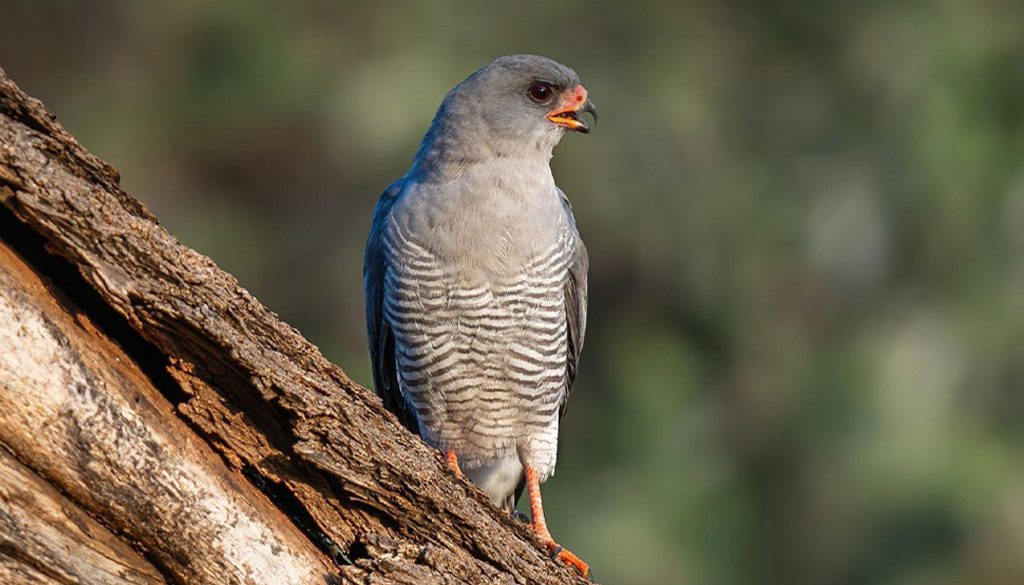
Identifying a lizard buzzard starts with understanding its distinctive silhouette and color palette. Measuring roughly thirty-five centimeters in length with a wingspan close to eighty centimeters, this medium-to-small bird of prey possesses a stocky, well-proportioned frame. At a distance, its overall body displays a sleek slate-grey mantle covering its head, upper back, and chest. However, as you get closer or bring your binoculars into focus, the finer details reveal a truly beautiful design. Below its solid grey chest, its lower breast and belly transition into a clean white surface patterned with delicate, dark horizontal bars.
Physical Characteristics and Facial Markings
The head and face offer some of the clearest diagnostic clues. Set against its cool grey crown, the bird’s cere—the fleshy patch at the base of its dark, hooked beak—glows a vivid orange-red. Its bare legs and feet match this vibrant pop of color, sharing the same rich reddish hue and standing out sharply against surrounding bark or foliage. Its eyes are intense, ranging from dark reddish-brown to black, giving the bird a focused, watchful expression as it scans the ground.
While many African raptors share grey and white plumage, the lizard buzzard sports a few specific markings that set it completely apart. Anyone learning how to identify a lizard buzzard must focus on its most famous field mark: the throat stripe. This is a thin, deliberate black line splitting a patch of stark white feathers right under the bill. In fact, this single vertical line is so unique among African birds of prey that scientists included it in its official Latin name, Kaupifalco monogrammicus, which translates to “single-lined.” If you see a small grey raptor and are unsure of its identity, check the throat first; if that crisp dark line is present, your search is over.
In-Flight Features and Wing Structure
When viewing the bird in flight or from below, another set of key field marks becomes visible. Its relatively short, broad wings are mostly white underneath, tipped with dark flight feathers that create a high-contrast outline in the sky. Its dark, slate-black tail features a single, broad white band running horizontally across the middle, capped with a fine white tip at the very end. Unlike larger buzzards or eagles that possess long, broad wings built for high-altitude soaring, the lizard buzzard’s shorter, slightly pointed wings are adapted for speed and maneuverability through dense branches and thick woodland canopies.
Perching Habits and Hunting Behavior
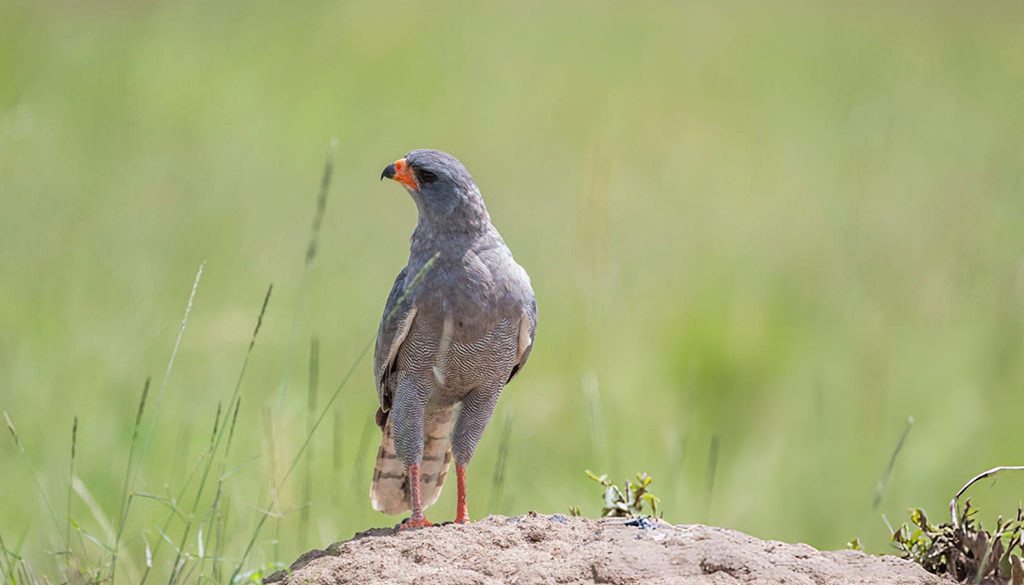
Behavioral traits provide another layer of clues for identification. The lizard buzzard is primarily a sit-and-wait predator. You will rarely catch it soaring high in the clouds or circling in thermals unless it is performing courtship rituals during the breeding season. Instead, it spends most of its time perched quietly on open branches, telephone poles, or fence posts, typically six to ten meters off the ground. Sitting motionless for long stretches, it maintains a patient watch over the terrain. When it spots movement, it drops swiftly from its perch in a low, gliding dive, dropping onto its target in the grass before returning to a tree to eat.
If you happen to catch one moving between trees, take note of its flight pattern. Rather than flying in a straight, steady line, the lizard buzzard moves with a characteristic undulating flight—a sequence of rapid, stiff wingbeats followed by a short glide, causing its path to rise and fall much like a thrush or a woodpecker. When traveling from one perch to another, it frequently drops low toward the ground before sweeping back up into the branches of a new tree.
Evolutionary History and Natural Diet
It is also worth noting that despite its common name, the lizard buzzard is not a true buzzard in the taxonomic sense. Evolutionary studies show it is much more closely aligned with hawks, particularly small woodland hawks, which explains its quick acceleration and agile flight style through thick vegetation. Its name stems entirely from its dietary habits. While it regularly eats grasshoppers, small rodents, frogs, and snakes, a substantial portion of its diet consists of small reptiles like agamas, skinks, and wall lizards, which it snatches off tree trunks, walls, and forest floors with effortless precision.
Help Me Plan My Trip
GET IN TOUCH
To contact an expert travel planner to start planning your adventure in Kenya, click the button below:


