What is the Largest Heron in the World?
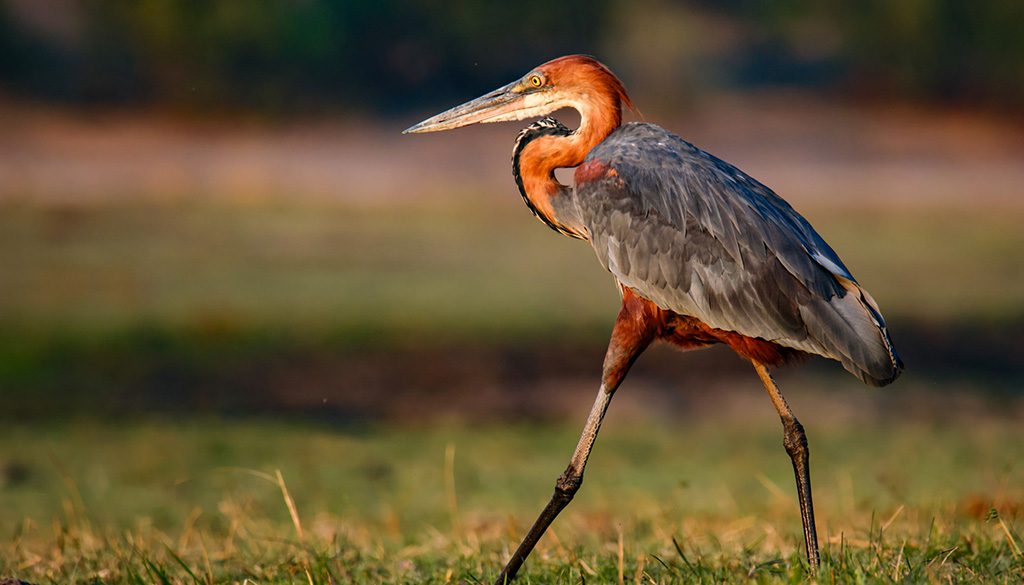
The Goliath heron is the world’s largest heron. Standing nearly five feet tall and weighing up to eleven pounds, this magnificent creature dwarfs its more common cousins. In fact, if you stood next to one on the riverbank, the top of its head would reach nearly to your chest. They truly live up to their reputation as the largest heron in the world. Their plumage is a study in earthy elegance: a cloak of deep slate-grey drapes across their back and wings, contrasting sharply with rich, chestnut-brown feathers that sweep down their long, serpentine neck, crown, and underparts. And then, of course, there is the weapon that defines their existence, a dagger-like bill that can measure nearly eight inches in length. Heavy, sharp, and built to withstand tremendous impact, it is the ultimate fishing spear.
Their greatest superpower isn’t brute force, but rather their stillness. While smaller shorebirds scurry frantically along the mudflats and kingfishers dive headfirst in bursts of chaotic energy, the Goliath heron practices an art form of supreme patience. It can spend up to seventy-five percent of its daylight hours standing completely motionless in the water. With its long, stilt-like legs planted firmly in the silt and its neck coiled in a relaxed S-curve, it blends seamlessly into the surrounding reeds, looking less like a living animal and more like a statue carved from river mud and shadow.
This meditative trance is anything but passive. Behind those piercing yellow eyes lies an intense, unwavering focus. Because of their extraordinary height and leg length, they can wade out much deeper than any other wading bird, venturing into chest-deep channels where smaller herons would lose their footing and be forced to swim. Being the largest heron in the world gives them exclusive access to a realm of much larger prey. It isn’t hunting for tiny minnows or water insects; it is waiting for substantial fish weighing several pounds apiece.
Masterful Hunting Tactics and Prehistoric Anatomy
Capturing the prize, however, is only half the battle. Watching a Goliath heron deal with a heavy, thrashing fish is an epic display of raw survival skill. The bird must lift the catch clear of the water, toss and maneuver it mid-air to align it headfirst, and gradually work the massive meal down its throat. Its neck visibly bulges as the fish descends, a testament to the elastic, rugged anatomy required to swallow prey whole that would choke almost any other bird. After such a monumental meal, the heron may retire to a quiet sandbar or an exposed branch, spreading its vast wings to dry in the sun, looking every bit like a pterosaur returned from the deep past.
Away from the solitary focus of the hunt, the Goliath heron’s life takes on a fascinating social dimension during breeding season. Scattered across sub-Saharan Africa, with smaller, isolated populations clinging to parts of South Asia and the Middle East, these birds are generally territorial and prefer their own company. Yet when the seasonal rains transform dry plains into sprawling lagoons, pairs come together to build a foundation for the next generation. Together, they construct colossal platform nests woven from thick sticks, reeds, and driftwood. Because a nest must support two giant adults and a brood of rapidly growing young, these structures can measure up to five feet across, large enough to hold a human being.
To keep their vulnerable offspring safe from terrestrial predators, they choose their real estate carefully. They favor secluded islands, low branches overhanging deep water, or rugged coastal cliffs. Inside this fortress of twigs, the female lays a clutch of two to five pale blue eggs. Both parents share the duties of incubation, taking turns shielding the eggs from the scorching tropical sun and sudden downpours. Once the chicks hatch, covered in scruffy grey down, the real struggle begins. Survival in the nest is a fierce, unforgiving affair. Driven by intense sibling rivalry, the chicks compete aggressively for the regurgitated fish their parents bring back from the marsh. In years when food is scarce, only the largest, most dominant chick will survive to fledge, ensuring that the parents’ exhausting efforts yield at least one strong survivor ready to face the wild.
Primordial Calls and Wetland Conservation
If you ever find yourself near one of these nesting sites, or walking along a quiet river bend at dusk, you might be fortunate enough to hear their voice. Most people expect them to chirp, whistle, or squawk, but the largest heron in the world communicates in a register that feels entirely primordial. When startled, defending their territory, or calling out to a mate across the water, they release a booming, raucous bark. Deep, resonant, and guttural, the call sounds remarkably like the distant baying of a large hound, carrying effortlessly across open water for up to two kilometers. Hearing that low, echoing cadence roll across a misty floodplain at dawn is a spine-tingling experience, an auditory reminder that you are standing in a landscape still governed by the untamed rhythms of nature.
Observing the largest heron in the world in its natural habitat highlights the vital importance of preserving healthy, thriving wetlands. These sprawling rivers, marshes, and coastal lagoons sustain entire ecosystems of fish, amphibians, and migratory birds. When we protect these waters from pollution and habitat loss, we ensure that the largest heron in the world continues to stand watch over the reeds for generations to come.
Help Me Plan My Trip
Don’t take our word for it
See what our clients have to say!


GET IN TOUCH
To contact an expert travel planner to start planning your adventure in Kenya, click the button below: