How Zebras Survive Predators: Stripes, Sleep & Herd Defense Science

Understanding how zebras survive predators requires looking beyond individual speed or physical strength. On the vast and open savannas of Africa, danger lurks behind every thicket, tall patch of grass, and murky watering hole. Apex carnivores like lions, spotted hyenas, leopards, and Nile crocodiles are constantly seeking an opportunity to strike. Yet, despite being a primary prey species, zebra populations continue to thrive across the wilderness. The secret behind how zebras survive predators lies in a complex matrix of biological adaptations, optical illusions, sensory fusion, resting mechanics, and collective intelligence.
Asynchronous Vigilance: The Unbroken Safety Umbrella
How do zebras manage to eat, sleep, and raise their young without constantly falling prey to the hunters lurking in the shadows? They do so through what field biologists call asynchronous vigilance. Watch any herd across the open grasslands, and you will notice that heads are almost never down simultaneously. Without a commander or formal shift change, the group naturally staggers its feeding routines. One animal grazes while its neighbor stands tall, chewing deliberately with eyes sweeping the distant ridgelines. Seconds or minutes later, the grazing zebra lifts its head to take over surveillance, allowing the watching zebra to dip down and feed. This unscripted, rhythmic rotation creates a continuous umbrella of safety, ensuring that at any given instant, multiple pairs of eyes and ears are scanning the environment for threats. This shared alertness is a fundamental pillar when analyzing how zebras survive predators in dense or open terrains.
Anatomical Multi-Sensory Alert Networks
The effectiveness of this shared duty is dramatically amplified by the physical anatomy of the zebra itself. A zebra’s eyes are set far back on the sides of its head, granting it a wide panoramic field of view that approaches nearly three hundred and sixty degrees. They possess excellent night vision and are exceptionally sensitive to subtle motion, allowing them to spot the slightest twitch of a golden tail in tall, dry grass. Complementing their vision are their large, highly mobile ears, which can rotate independently like radar dishes to pinpoint low-frequency sounds—such as the soft rustle of dry leaves or the quiet padding of paws across hard earth. When a zebra is on guard duty, it fuses these high-powered sensory tools with its surroundings, acting as a live transmitter for the rest of the herd. This sensory combination plays a massive role in how zebras survive predators during dark nighttime hours when big cats actively hunt.
Social Hierarchies and Sentry Assignments
Within a typical zebra group, social structure also dictates who watches when and where. A core harem usually consists of a single dominant stallion, several mature mares, and their young offspring. While vigilance is shared by all adult members, the dominant stallion often assumes the most high-stakes sentry duty. When the herd moves to vulnerable locations—such as dense thickets or waterholes where lions frequently set ambushes—the stallion typically takes up a protective position at the rear or along the flank. From this vantage point, he monitors the surrounding landscape, allowing the nursing mares and young foals to drink and graze with reduced anxiety. Mares, particularly those protecting newborn foals, also display heightened levels of vigilance, constantly monitoring both their immediate surroundings and the movement of their young. Understanding social roles provides key insights into how zebras survive predators while raising vulnerable young.
Postural Alarms and Silent Herd Communication
The communication system that powers this shared detection network is remarkably subtle yet instantaneous. High-stress situations do not always require loud, frantic alarm calls, which might betray the herd’s exact position to an undetected stalker. Often, the initial alarm is entirely visual and behavioral. If a guard zebra detects a suspicious movement, its posture freezes instantly. Its ears lock forward, its neck stiffens, and its head turns rigidly toward the point of interest. This sudden freeze sends an immediate ripple effect through the entire herd. Nearby zebras pick up on the abrupt change in posture and lift their own heads, instantly orienting in the exact same direction. Within seconds, a dozens-strong herd transforms from a scattered group of peaceful grazers into a synchronized array of alert, focused onlookers. This rapid behavioral transmission is another clear example of how zebras survive predators without giving away their location unnecessarily.

Optical Illusions: Dazzle Camouflage in Motion
Beyond behavioral defense, a zebra’s coat plays an indispensable role in daily survival. Scientists long debated the evolutionary purpose of black and white stripes, but recent studies highlight the effect known as “motion dazzle.” When a herd panics and bolts together, the overlapping high-contrast stripes create a chaotic visual field for a predator. To a lion trying to target a single individual, the boundaries of individual animals blur into a confusing mass of moving lines. This sensory overload makes it exceedingly difficult for a predator to judge speed, distance, and direction, often causing them to miss their strike. This optical phenomenon explains how zebras survive predators during high-speed chases across open plains.
Interspecies Coalitions and Shared Defense Grids
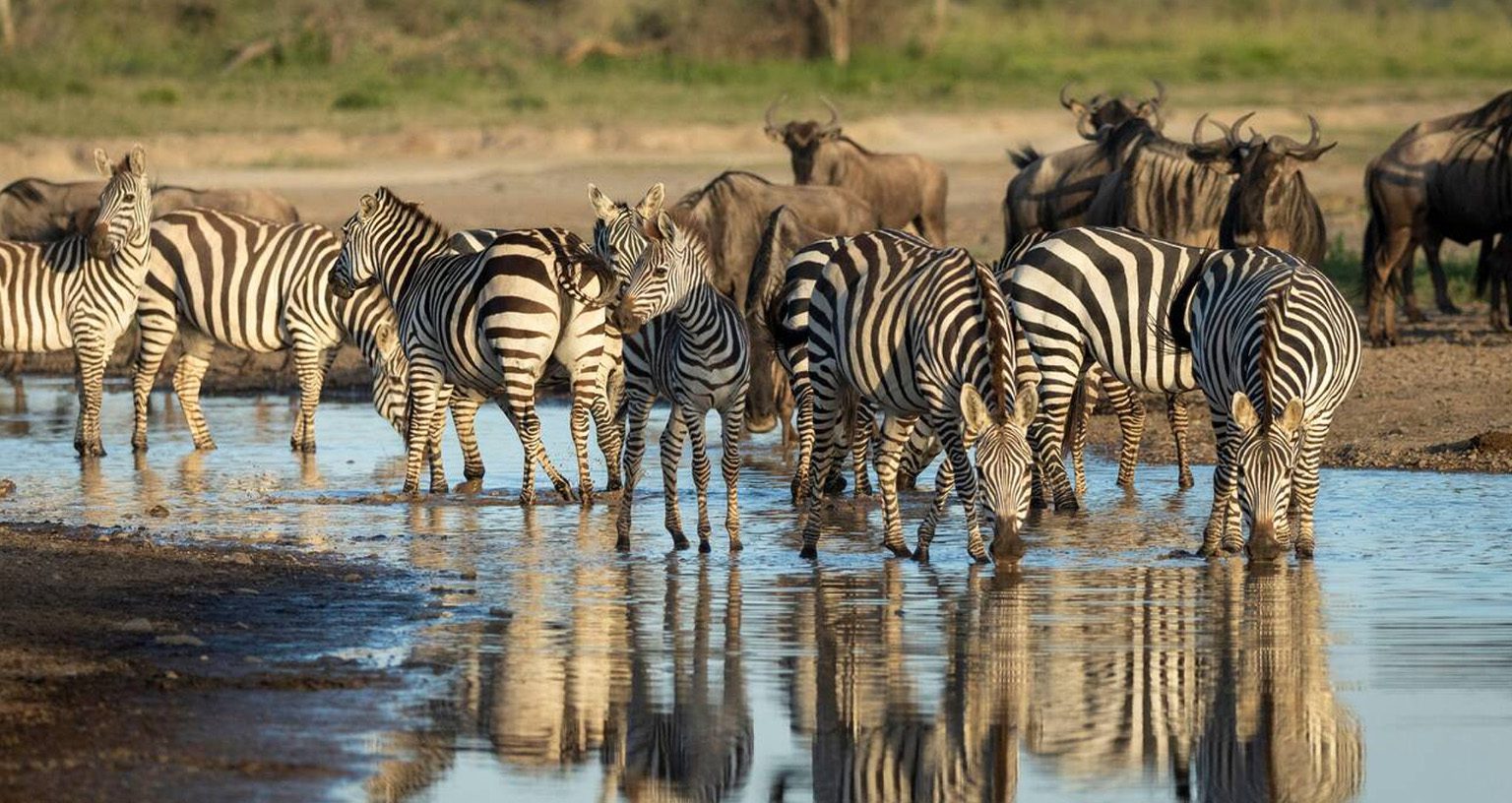
Interestingly, zebras do not limit this shared sentinel system to their own kind. On the vast African plains, they frequently form mixed-species aggregation groups, grazing alongside wildebeests and ostriches. This interspecies partnership creates an even more formidable multi-sensory defense grid. While zebras excel with superior vision and high-contrast motion detection, wildebeests bring an exceptional sense of smell, capable of catching the wind-borne scent of a predator hidden far upwind. Ostriches, standing tall with their elevated eye level, offer long-range visual tracking over high grasses. By feeding together, zebras tap into a broader sensory network, reading the alarm behavior of neighboring species and sharing their own early detection cues in return. Combining forces across species lines demonstrates how zebras survive predators through mutual ecological cooperation.
Unique Sleep Mechanics and Resting Security
Sleep is one of the most dangerous states for any wild prey animal, yet zebras have evolved brilliant physiological workarounds. Zebras can sleep while standing upright, thanks to a “stay apparatus”—a system of tendons and ligaments that lock their legs in place without requiring active muscular exertion. This allows them to catch light slow-wave sleep while remaining ready to sprint at a moment’s notice. Deep REM sleep, which requires lying down completely, is only undertaken in broad daylight when the rest of the herd is standing guard. By staggering sleep cycles and utilizing anatomical leg-locks, zebras minimize downtime vulnerability.
Help Me Plan My Trip
GET IN TOUCH
To contact an expert travel planner to start planning your adventure in Kenya, click the button below: