10 Interesting Facts About the Bushbuck: Africa’s Most Mysterious Antelope

The Bushbuck is one of Africa’s most intriguing creatures, beautiful, shy, unpredictable, and almost ghost-like in the way it slips through dense forests without being heard. For many safari travelers, the Bushbuck is a fleeting glimpse between the trees, a momentary flash of stripes and russet fur. But behind that brief sighting lies a world of complexity and surprising behavior that makes this antelope one of the most fascinating animals in Africa.
Below are 10 interesting facts that reveal the Bushbuck’s mysterious nature, celebrating why this elegant antelope deserves far more attention.
1. They are Africa’s Most Widespread Antelope
Unlike many antelope species restricted to specific ecosystems, the Bushbuck thrives almost everywhere: forests, mountains, woodlands, swamps, riverbanks, and even semi-urban areas. It has one of the widest distributions of any African antelope.
Its ability to adapt to different habitats is part of its mystery. Bushbucks can disappear into thick vegetation almost instantly, blending into their surroundings without making a sound.
2. They Are Surprisingly Solitary and Introverted
While many antelopes live in herds to increase their chances of survival, the Bushbuck prefers solitude. It spends most of its life alone, forming no permanent group except occasionally a mother with her young.
This solitary nature makes it hard for predators and humans to predict its behavior. Its introverted personality also minimizes noise in the forest, helping it stay undetected.

3. They Rely on Stealth Instead of Speed
Cheetahs use speed. Buffalo use strength. Zebras use herds.
But the Bushbuck? It uses silence.
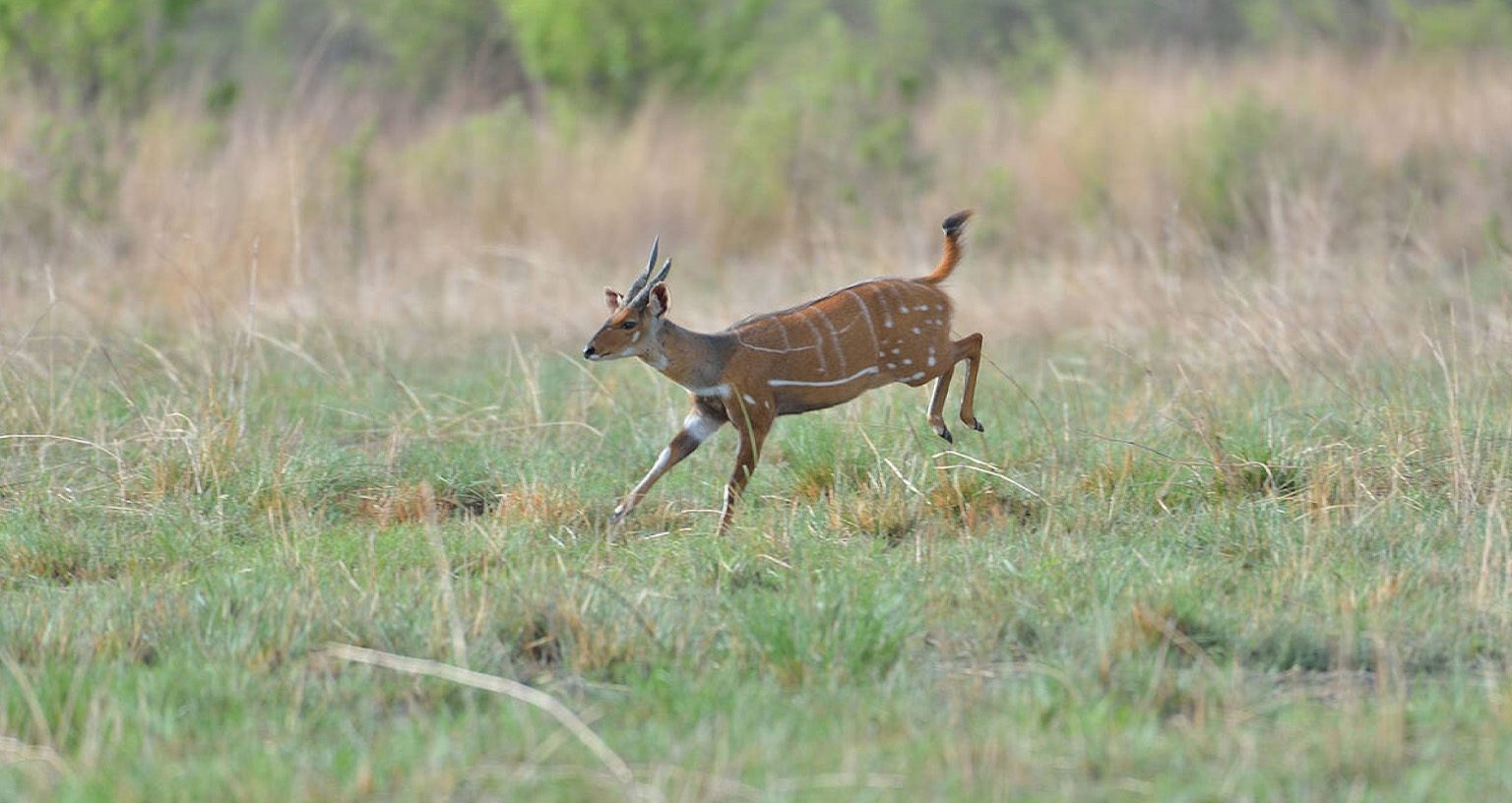
When danger approaches, a Bushbuck freezes rather than flees. Only when a predator gets too close does it suddenly dart away in short, explosive bursts. Its movements are so quiet and controlled that trackers often say you “hear the Bushbuck only after it’s gone.”
4. Males Are Territorial – And Can Be Fiercely Defensive
Though the Bushbuck appears gentle and shy, males can become extremely aggressive when defending their territory. Their sharp, spiraled horns are powerful weapons, used in intense fights with rivals or when cornered by predators.
This rarely seen aggressive side makes it one of Africa’s most unpredictable antelopes.
5. They Display Beautiful and Unique Markings
Every Bushbuck has a unique pattern of white spots, stripes, and patches—almost like a fingerprint.
Males are darker and often chestnut or chocolate brown, while females are lighter with more noticeable markings. These patterns help them blend into broken forest light, confusing predators like leopards.
The beauty and variation of their coats make the Bushbuck one of the most visually striking antelopes in Africa.

6. They Are Mostly Nocturnal – A Secret Nightlife
The Bushbuck prefers to move under the cover of darkness. Most feeding happens at dusk, night, and dawn. During the heat of the day, they hide in thick shrubs or forest shadows.
Because they are so active at night and so quiet, scientists still have gaps in their understanding of Bushbuck social structure, range size, and communication.
7. They Are Browsers with a Surprisingly Flexible Diet
The Bushbuck feeds primarily on leaves, fruits, flowers, twigs, and shrubs. But it is remarkably adaptable. When food is scarce, it can eat almost any plant material available.
This flexible diet is a major reason it thrives in so many habitats across Africa. During the dry season, when many animals struggle, the Bushbuck continues feeding on evergreen shrubs and fallen fruits.
8. Mothers Hide Their Young in Secret “Nurseries”
Bushbuck mothers rarely keep their newborns close to them. Instead, they hide the fawns deep in thick vegetation—sometimes in the same hidden spot for weeks. The mother returns only to nurse the baby.
This strategy reduces scent trails and keeps predators from locating the young. A hidden fawn remains perfectly still, depending entirely on camouflage for survival.
9. They Communicate Through Soft Barks and Scent Signals
Although quiet most of the time, the Bushbuck can produce a sharp, dog-like bark when alarmed. This bark warns other animals of danger.
They also rely heavily on scent. Males mark their territory using glands and urine, leaving invisible signals that communicate dominance and boundaries to other Bushbucks in the area.
10. They Are One of Africa’s Most Underrated Safari Highlights
Because of their shy nature, they are not as famous as wildebeests or impalas. But for many experienced safari guides, seeing a Bushbuck is a privilege. It means you’ve ventured into quiet, undisturbed corners of the wild—places where nature still feels ancient and untouched.
It symbolizes Africa’s deep, hidden wilderness. It is not an animal you chase. It is an animal you discover only when you slow down, stay quiet, and let the forest reveal its secrets.
Help Me Plan My Trip
GET IN TOUCH
To contact an expert travel planner to start planning your adventure in Kenya, click the button below: