

Is a Greater Kestrel a Falcon or Hawk?
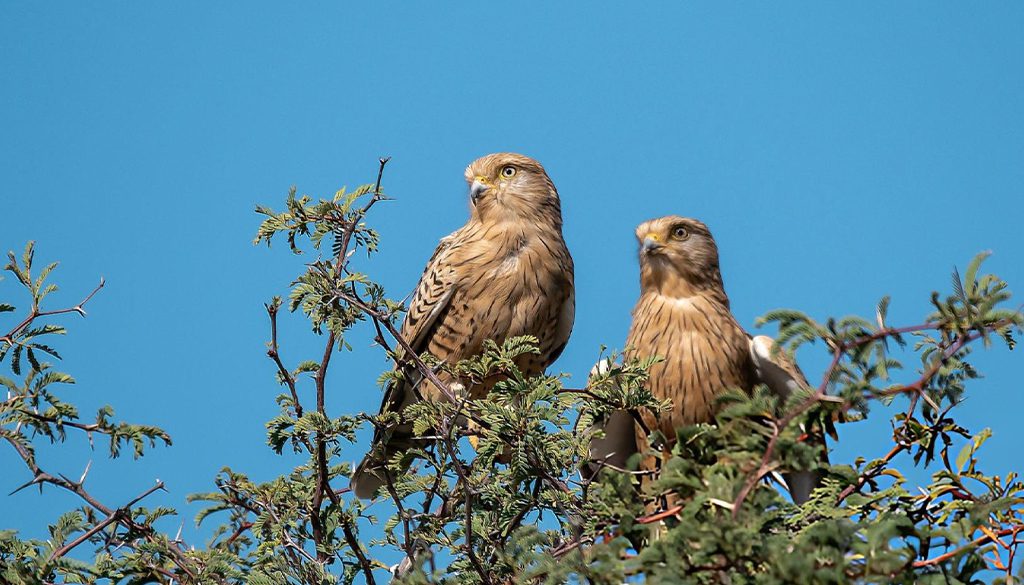
Is a Greater Kestrel a falcon or hawk? To clear up the mystery right at the start, the Greater Kestrel is undeniably a falcon. But beneath that simple anatomical answer lies one of the most intriguing evolutionary tales of the African skies – a story about incredible adaptation, mistaken identity, and an evolutionary ancestry that completely upended what scientists thought they knew about birds of prey.
The Evolutionary Plot Twist
For centuries, naturalists lumped falcons and hawks into the exact same family tree, assuming that any bird equipped with curved talons, a hooked beak, and a thirst for live prey must share a recent common ancestor. It made intuitive sense. When you look at a hawk soaring over a field and a falcon scanning from a telephone pole, their lives seem nearly identical. Yet modern genetics revealed a plot twist that surprised even seasoned ornithologists: falcons are not closely related to hawks at all.
In fact, genetically speaking, a falcon like the Greater Kestrel is vastly more closely related to a common parrot or a songbird than it is to an eagle, a red-tailed hawk, or a harrier. The striking physical similarities between hawks and falcons are actually a classic example of convergent evolution—the process where entirely unrelated creatures independently evolve similar physical traits because they are adapting to the exact same lifestyle and environmental challenges. So when asking whether a Greater Kestrel is a falcon or a hawk, the genetic evidence clearly points to the falcon lineage.
Anatomical Blueprints: Falcon vs. Hawk
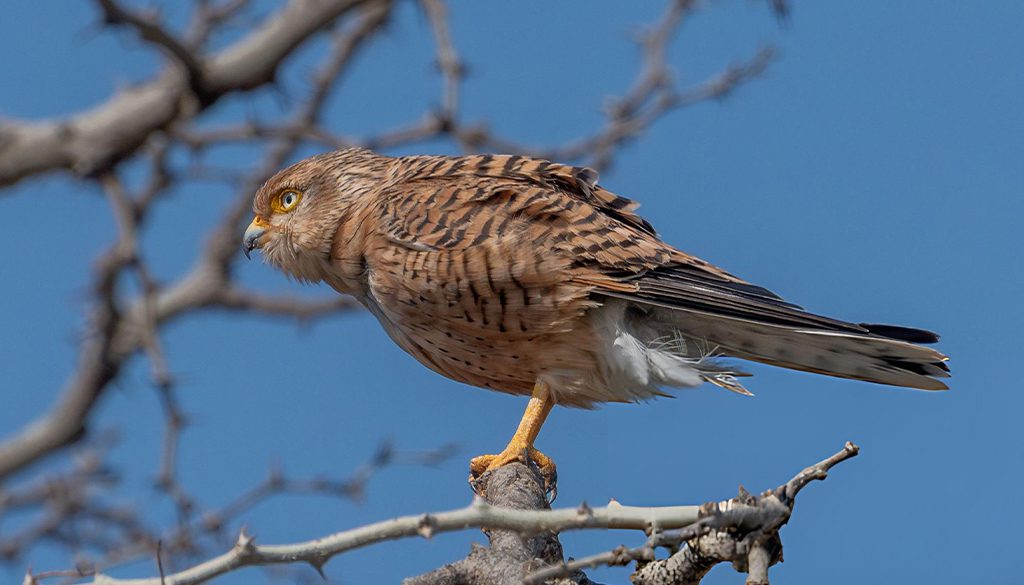
If you examine a Greater Kestrel up close, its true identity reveals itself through subtle, unmistakable physical blueprints. Hawks tend to have broad, rounded wings built for soaring effortlessly on warm air currents over forests and open fields, maneuvering through dense trees with short bursts of power. Falcons, on the other hand, carry long, pointed wings engineered for speed, agility, and precise aerial mechanics.
Look closely at a Greater Kestrel’s beak, and you will notice a small, sharp tooth-like projection on the upper mandible known as a tomial tooth, matched by a corresponding notch on the lower beak. While a hawk relies almost entirely on the crushing strength of its powerful feet to dispatch prey, a falcon uses its specialized tomial tooth to sever the spinal cord of its catch with surgical swiftness.
Physical Traits of the Greater Kestrel
The Greater Kestrel (Falco rupicoloides) is particularly fascinating because it is one of the largest kestrel species inhabiting the vast, open grasslands, arid savannas, and semi-deserts of Southern and Eastern Africa. Draped in pale, rufous plumage heavily streaked with dark brownish-black bars across its back and wings, it blends seamlessly into the sun-bleached brush of the Kalahari or the vast expanses of the Rift Valley.
Its most striking feature, however, is its pale, ghostly white eyes. Unlike many of its dark-eyed relatives, the adult Greater Kestrel gazes out at the world with an icy, whitish-yellow iris that gives it an intense, penetrating look as it scans the terrain for movement.
Aerial Mastery and Hunting Tactics
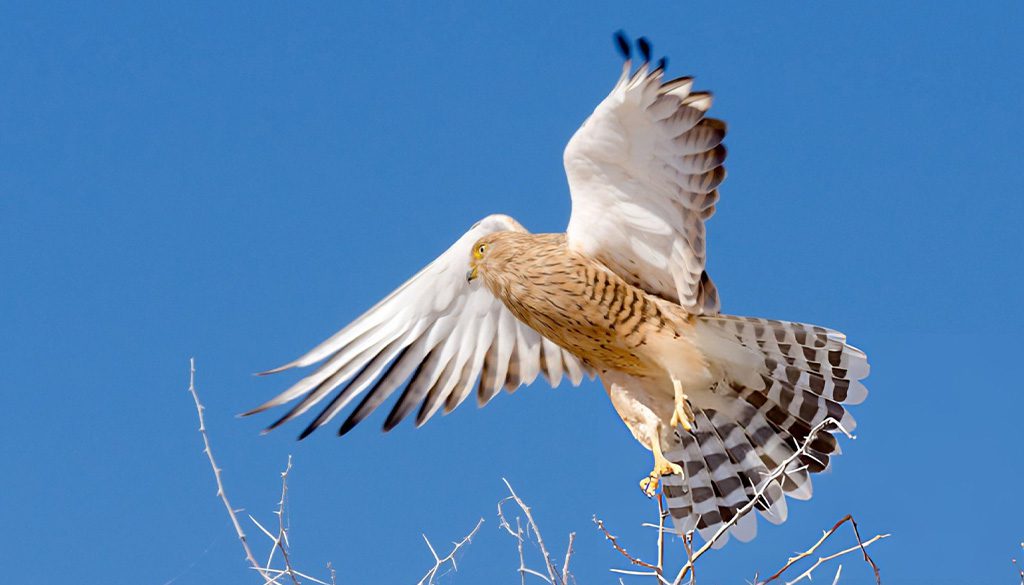
Life in Africa’s arid expanses demands exceptional hunting tactics, and this is where the kestrel truly shines. While most falcons are known for high-altitude, hundred-mile-an-hour stoops on flying birds, kestrels master a far more grueling aerial discipline: hovering.
-
Wind-Riding Position: A Greater Kestrel flies directly into an oncoming breeze, adjusting its pointed wings and fanning its tail with minute, automatic corrections.
-
Head Stabilization: It holds its head completely still in mid-air as if anchored to an invisible crane, keeping its eyes locked on the ground.
-
Spotting the Prey: From this floating vantage point, its hyper-focused vision can spot the slight rustle of a lizard, a grasshopper, or a small rodent buried deep in the grass dozens of meters below.
-
The Plunge: Once the target is locked, the kestrel folds its wings and drops, executing a controlled plunge to strike before the prey even realizes danger is hovering above.
Nesting Habits and Human Adaptation
Beyond its specialized hunting skills, the Greater Kestrel’s daily life highlights how perfectly adapted true falcons are to open, dry environments. Unlike hawks, which often construct large, elaborate stick nests high in tree forks, falcons do not build their own nests from scratch. Lacking the instinct or anatomical habit to weave twigs together, the Greater Kestrel relies on ingenuity and opportunity.
It frequently takes over the abandoned stick nests built by crows, ravens, or other raptors, occasionally nesting on high rock ledges or the crowns of thorny acacia trees. In some regions, these adaptable birds have even taken advantage of human infrastructure, nesting atop utility poles where the elevated platforms offer a commanding view of the surrounding savanna.
Help Me Plan My Trip
GET IN TOUCH
To contact an expert travel planner to start planning your adventure in Kenya, click the button below:


