Why is it Called a Blue Wildebeest?

Why is it called a blue wildebeest? The answer starts with the coat. Step back and watch a herd from a distance, especially in the soft light of early morning or late afternoon, and the animals take on a slate-gray tone with a metallic, bluish sheen. Early European naturalists and settlers noticed it, and the name stuck. Up close, though, the story gets more modest. The coat is really a silvery gray, sometimes leaning toward brown, marked with dark, vertical streaks across the neck and shoulders, almost like faint brushstrokes. Those streaks are why it’s also called the brindled gnu. So “blue” is partly the animal and partly the light, a nickname born from how the herd looks across a wide, shimmering landscape.
The name also helps tell it apart from its close cousin, the black wildebeest. That one lives farther south, with a much darker coat, nearly black, and a flowing white tail. Put the two side by side, and the naming makes sense. One is dark as charcoal, the other cool and silvery. Of the two, the blue wildebeest is the far more widespread, found across eastern and southern Africa.
But the word “wildebeest” has a story of its own. It comes from Afrikaans, which grew out of Dutch, and it means, quite literally, “wild beast.” Early Dutch-speaking settlers in southern Africa looked at this strange creature and didn’t quite know what to call it. And no wonder. The wildebeest looks like it was assembled from spare parts, sporting the heavy front shoulders of an ox, the slender legs of an antelope, and a shaggy mane and beard.

Origins of the Gnu and Early Savanna Naming
You may also have heard the blue wildebeest called a gnu. That word has an even older origin. It’s thought to come from the San peoples of southern Africa, and it imitates the sound the animal makes, a deep, nasal grunting call that carries across the plains. Listen to a herd at night, and you’ll understand. It’s a low, honking, almost comical sound, repeated again and again, a whole landscape of animals talking to one another in the dark.
So the blue wildebeest is, in a sense, named three ways: for its color, for its wild appearance, and, in the case of the gnu, for its voice. Few animals carry a name that tells so much about how people first met them. Each part of the label captures a sensory impression from the savanna—what early observers saw shimmering in the grass, what startled them about its rugged build, and what echoed through the night air around their camps.
But the color is only the beginning of what makes this animal remarkable. The blue wildebeest is the star of one of the greatest wildlife spectacles on Earth, the Great Migration. They don’t travel alone. Hundreds of thousands of zebras and gazelles join the journey, and the combined movement is so enormous that it can be seen from space. Following the seasonal rains in an endless search for fresh grazing, the blue wildebeest drives the rhythm of the Serengeti-Mara ecosystem.
It’s a journey full of danger. Lions, hyenas, and leopards all wait along the way. The most dramatic moments come at the rivers, where the herds gather on the banks, hesitating, shifting, until one brave animal leaps in and the rest surge after it. Some are swept away, some are caught by Nile crocodiles, but most make it across, scrambling up the far bank and carrying on, because staying behind means starvation.
Survival, Birthing Season, and Savanna Resilience
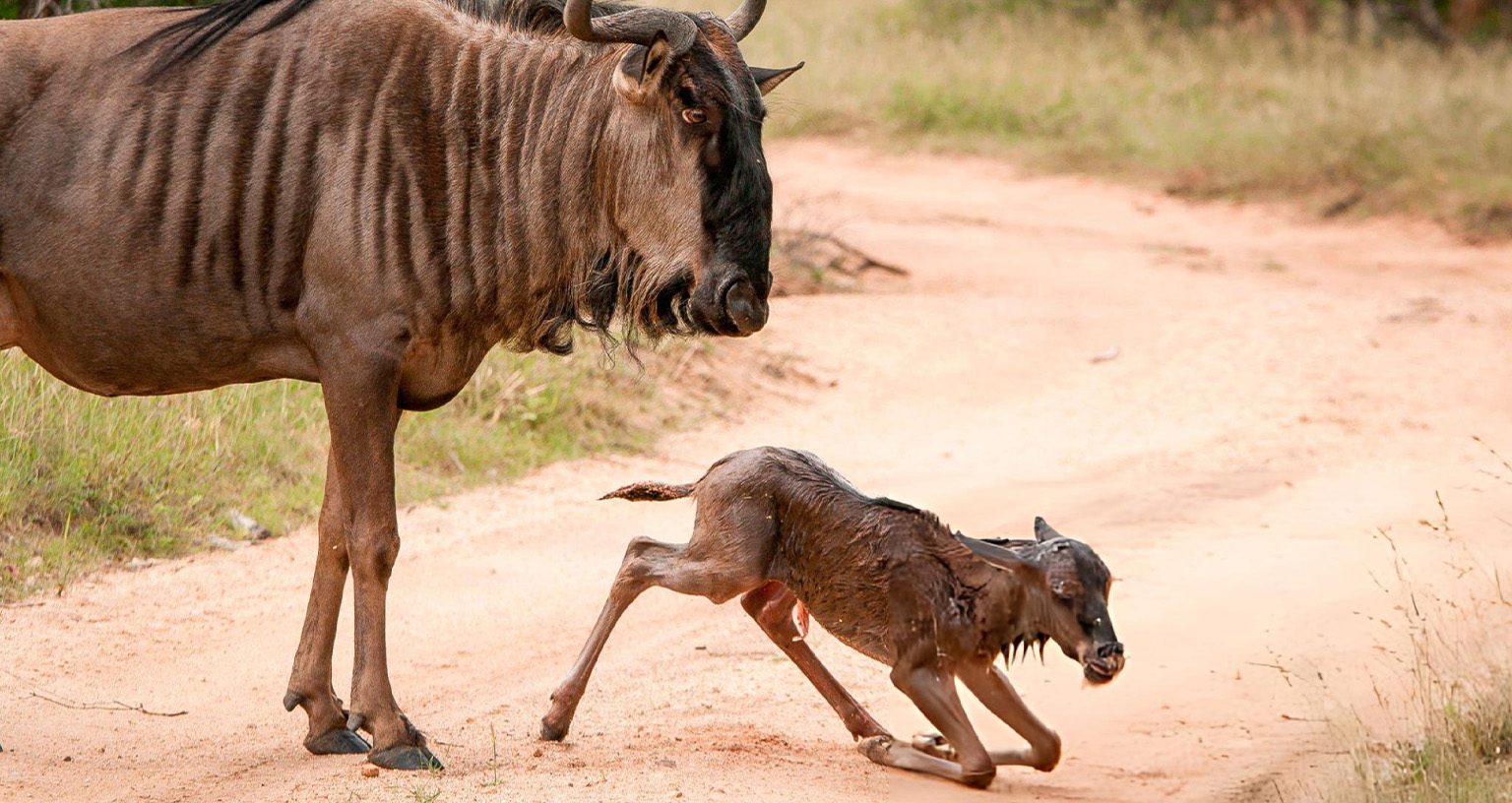
And then there’s the birthing season, which may be the most astonishing part of all. In the southern Serengeti, usually around February, hundreds of thousands of calves are born within just a few weeks. It’s a kind of synchronized timing that overwhelms predators. There are simply too many calves for them to catch, so most survive. And the calves themselves are extraordinary. Within minutes of being born, a blue wildebeest calf can stand on wobbly legs, and within a day or so, it can run alongside its mother. In open grassland where danger is everywhere, that speed is a matter of life and death.
Unlike the adults, the newborn calves aren’t blue at all. They’re a warm, tawny brown, the color of dry grass, which provides vital camouflage during their most vulnerable days. As they grow, their coats gradually darken and cool, shifting over time toward the silvery gray that gives the species its name. So every blue wildebeest starts out as something else entirely before earning its signature hue.
It’s easy to overlook this animal. Next to a lion or an elephant, the wildebeest can seem plain, even awkward. But look closer, and you find a creature perfectly built for the life it leads: tough, tireless, social, and endlessly resilient. It can walk hundreds of miles in a year, survive on little more than grass, and thrive in enormous herds, where safety comes from sheer numbers and constant collective vigilance.
So the next time you see that name, blue wildebeest, remember what’s behind it. A shimmer of silver-gray light across the plains. A “wild beast” named by settlers who had never seen anything like it. A call that gave the world the word gnu. And a living tide of animals that has crossed the African grasslands for thousands of years, long before anyone thought to give it a name.
Help Me Plan My Trip
Don’t take our word for it
See what our clients have to say!


GET IN TOUCH
To contact an expert travel planner to start planning your adventure in Kenya, click the button below: